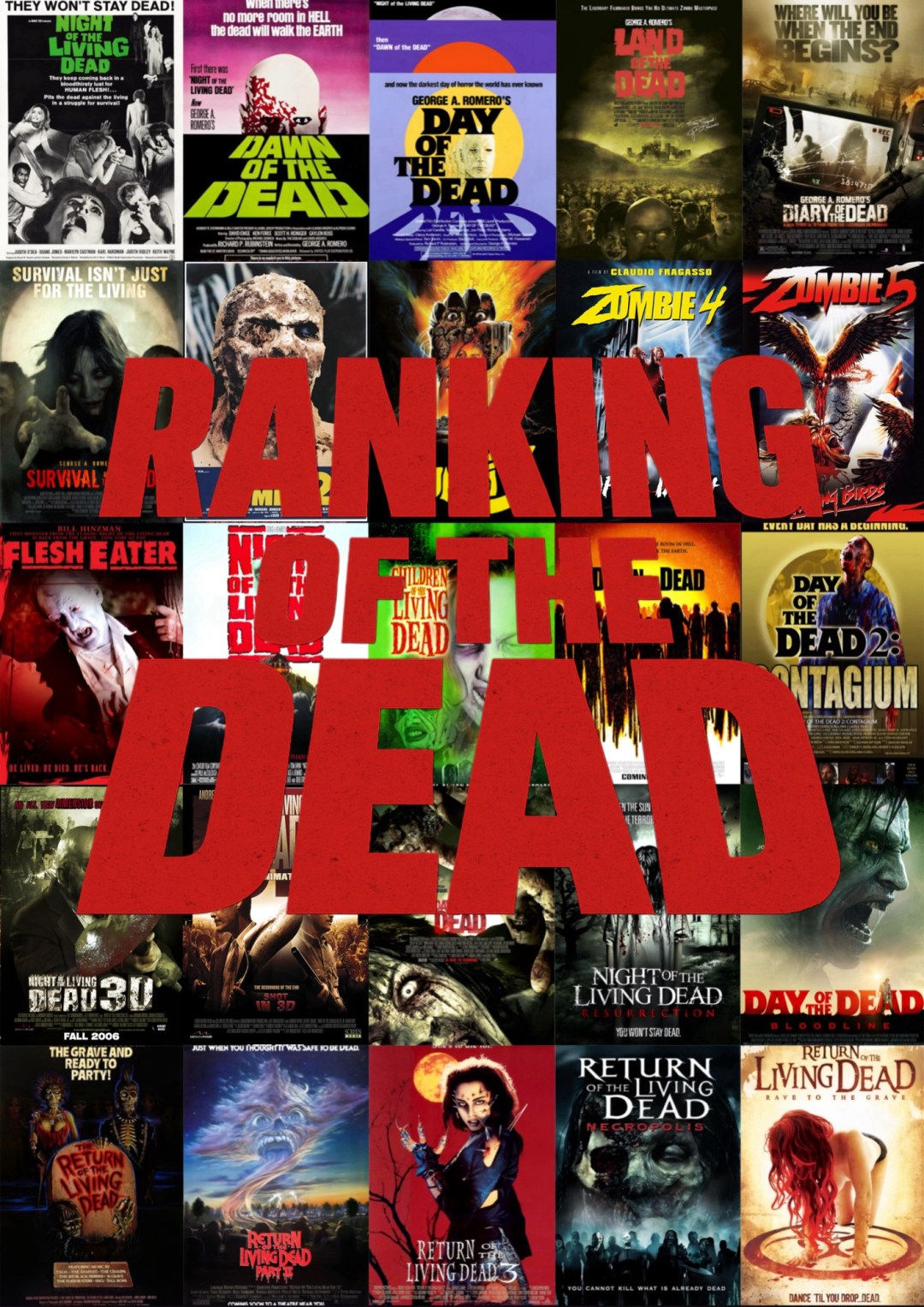
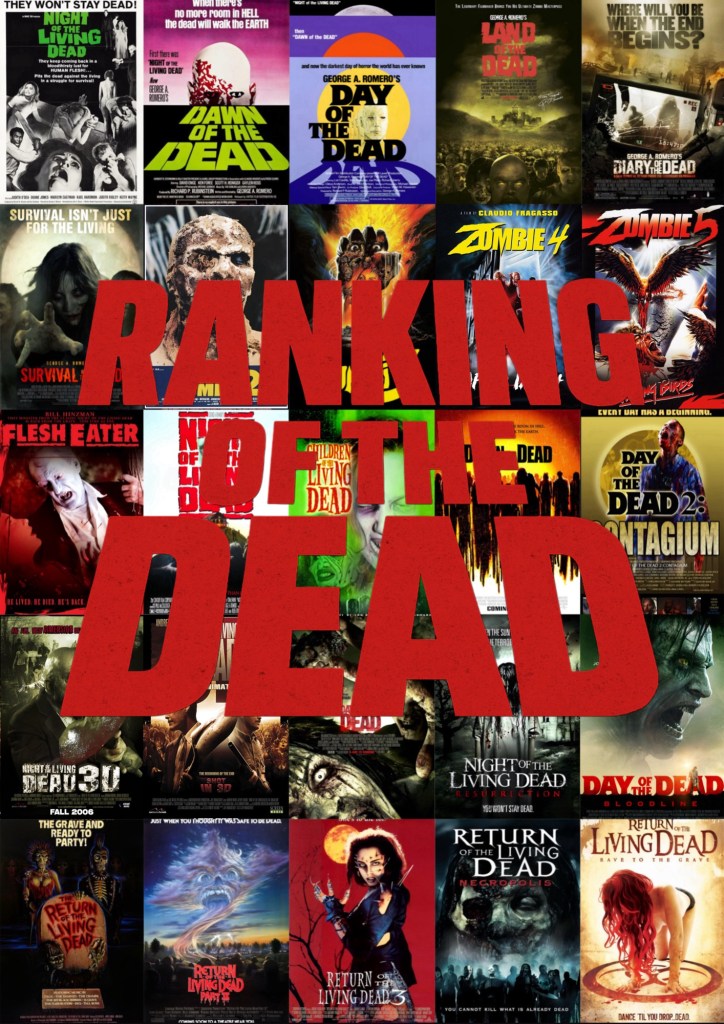
I’m finally getting back to blogging — it’s been a long, long time — but I’m hoping to do it more often going forward. For my first post in three years, I wanted to start with something big, something I’ve wanted to tackle for quite a while: the legendary George A. Romero’s Living Dead franchise. Before diving in, though, I want to talk about how much I appreciate the zombie subgenre as a whole, because it often doesn’t get the credit it deserves.
Zombie horror is incredibly versatile. You see it across so many mediums, from video games like Resident Evil, Dying Light, and Telltale’s The Walking Dead, to TV shows like Z Nation and The Walking Dead, and of course films like Romero’s classics, 28 Days Later, and Train to Busan. Unlike vampires or werewolves, zombies have a visceral, grounded quality to them — there’s often a frightening realism rooted in viral outbreaks, societal collapse, and mass panic, whether it’s the rage virus in 28 Days Later or the wildfire virus in The Walking Dead. Because of that, the genre can tell wildly different stories while still feeling disturbingly plausible, which is what makes it so compelling.
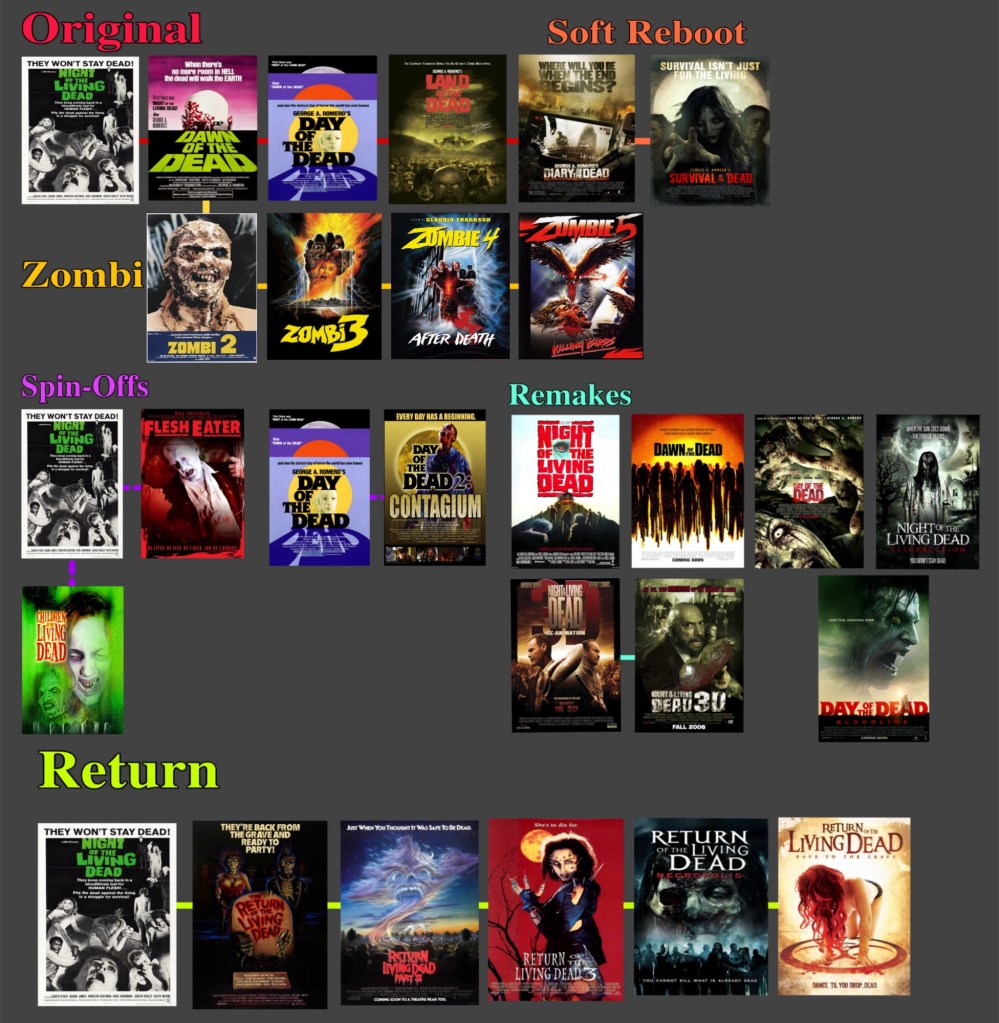
With that said, this journey will span Romero’s original films, both official and unofficial sequels and remakes, spin-offs like the Italian Zombi “series,” and John A. Russo’s Return of the Living Dead franchise. Many of these will be first-time viewings for me, as I had only seen 6 of the 25 films on this list before starting this project. I don’t normally use decimal points in my ratings to this extent, but with such a massive list, I had to in order to avoid repeating numbers.
25. Children of the Living Dead (2001)
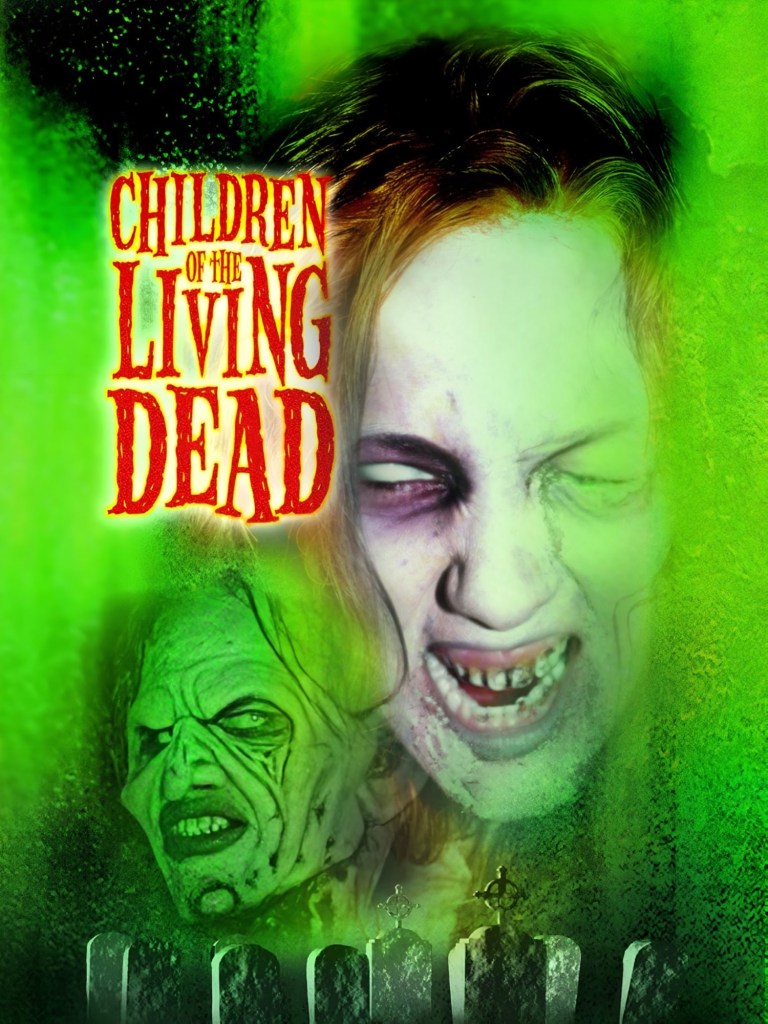
All I can say is wow — this is bad, bad, bad, bad. Before even getting into the film itself, it was completely hampered from the start due to severe behind-the-scenes mismanagement. Producer and writer Karen Lee Wolf essentially took over the production, causing constant issues with the cast, crew, and director. She reportedly stayed on set throughout filming and even threatened to fire anyone who questioned her script. John Russo later called it the worst film he ever worked on. Tom Savini, who appears in the movie, said it was originally intended to be a serious horror film but completely fell apart. Director Tor Ramsey wanted legitimate actors, but was pressured into hiring only Wolf and Russo’s friends, many of whom were paid absurdly high salaries.
This film is a direct-to-video sequel to the already poorly received colorized and edited 30th Anniversary Edition of Night of the Living Dead — a version not approved by George A. Romero — making this an unofficial sequel to Romero’s original film. The plot follows the disappearance of serial killer and rapist Abbot Hayes from a morgue in 1987, shortly before a zombie outbreak devastates his hometown. Fourteen years later, the town attempts to bury its past, only for a businessman relocating cemetery bodies to awaken Hayes, who sets out to build his own undead army.
The result is a dismal, boring, and unnecessarily complicated mess. The film is all over the place, plagued by terrible acting, awful editing, flat cinematography, a nonsensical plot, and painfully obvious ADR that constantly pulls you out of the movie. It’s an absolute chore to sit through and easily one of the worst films I’ve ever seen. For that, it gets a 1 out of 10 — and if I could go lower, I absolutely would.
Rating: 1/10
24. Day of the Dead 2: Contagium (2005)
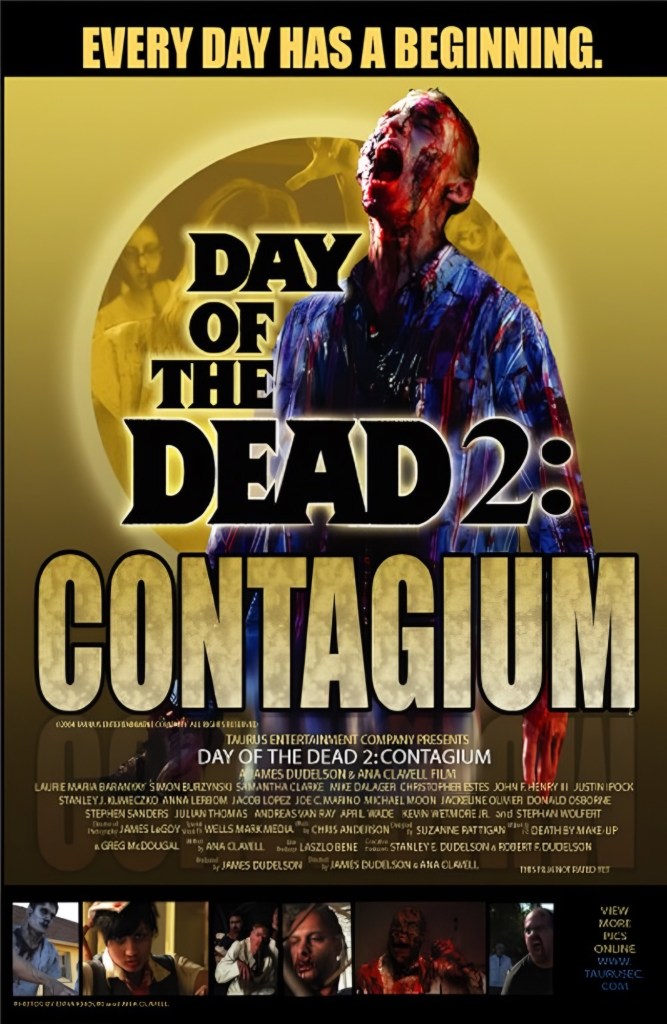
Just like Children of the Living Dead, this is an unofficial straight-to-video sequel to Day of the Dead, and just like Children of the Living Dead, it’s nearly as bad. The plot goes like this: in 1968, the military levels a facility after a lethal bacteria is released. Thirty-seven years later, a patient on an outing from a mental institution stumbles upon an old thermos which—once opened—releases the bacteria and turns people into zombies. That’s really all there is to it.
And once again, I hate to repeat myself, but just like Children of the Living Dead, this film is packed with bad acting, poor makeup and effects, and an incredibly boring, lifeless plot. All this movie does is slap the Day of the Dead label onto itself and call it a sequel, which feels like a complete disgrace to Romero and the Dead franchise. It’s no surprise, though, considering the writer and director, Ana Clavell, would later go on to write and direct the absolutely awful Creepshow III.
I’m giving it a 1.25 out of 10, and that’s only because it somehow looks slightly better than Children of the Living Dead, reportedly having been shot on 35mm—which I honestly find hard to believe because it certainly doesn’t look like it. Avoid and skip this one entirely. I’m watching these films in series and release order, and between Children of the Living Dead and this, I’m seriously starting to question why I’m putting myself through this.
Rating: 1.25/10
23. Diary of the Dead (2007)

Words can’t describe how massively disappointed I was with this film, but I’ll try my best. It feels like a then-67-year-old Romero completely lost his creative touch. Diary of the Dead acts as a soft reboot of the franchise, taking us back to the start of the outbreak because, I guess, Romero couldn’t figure out how to move forward after Land of the Dead. Set in the then-present day, the film dives into themes of media manipulation, misinformation, self-documentation, and even plays as an allegory for the Iraq War. But the execution is rough. It feels like it was aimed at a younger teenage demographic, especially with the found-footage style and a cast full of annoying, unlikable characters who speak in that overly “teen movie” dialogue and act like caricatures.
It’s honestly shocking how far Romero’s quality drops here. This barely feels like the same filmmaker behind the legendary original trilogy. The whole thing comes across like a Syfy Channel original or something The Asylum would pump out. It did get a very small theatrical run, but after that it went straight-to-video, and the quality fits that. If it isn’t obvious already, this is a 1.5 out of 10 for me. If there’s one positive note, it’s seeing a then-up-and-coming Tatiana Maslany (who’d later star in Orphan Black and She-Hulk) pop up briefly. But that’s about it.
Rating: 1.5/10
22. Survival of the Dead (2009)
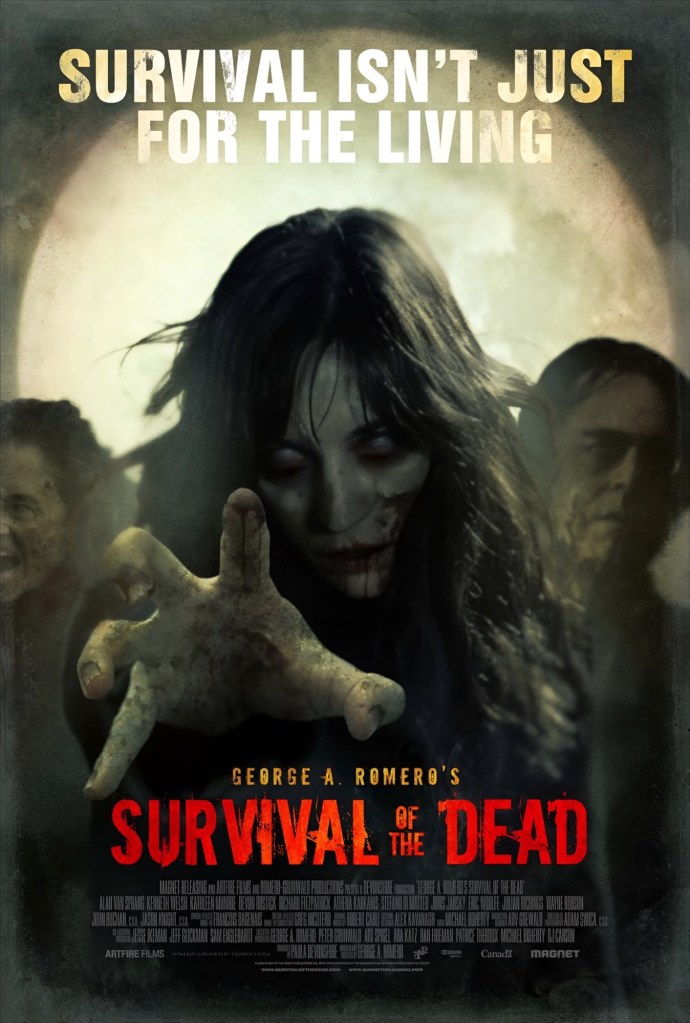
Romero’s last entry in the franchise, picking up directly after Diary of the Dead—and thankfully, this time it isn’t found footage. Unfortunately, it still suffers from many of the same problems as Diary: uninteresting characters, rough CGI, and social commentary that feels forced rather than thoughtful, showing just how much Romero had lost his creative edge and subtlety by this point.
The film leans heavily into themes of tribalism, generational feuds, and stubborn old-world grudges, playing out like a Hatfield vs. McCoy Western with zombies in the background. The undead barely feel like the threat here; instead, we’re stuck with yet another cliché story where the living are the true danger. It’s really no surprise this one went straight-to-video.
This wasn’t intended to be Romero’s final chapter—he had at least two more films planned, including Road of the Dead—but his declining health and eventual passing in 2017 meant those ideas never materialized. On a positive note, I can say this is slightly better than Diary of the Dead, but not by much. It’s a 1.75 out of 10, and it’s a shame this ended up being Romero’s last film.
Rating: 1.75/10
21. Zombi 5: Killing Birds (1988)
AKA Killing Birds, Raptors, Zombie Flesh Eaters 4
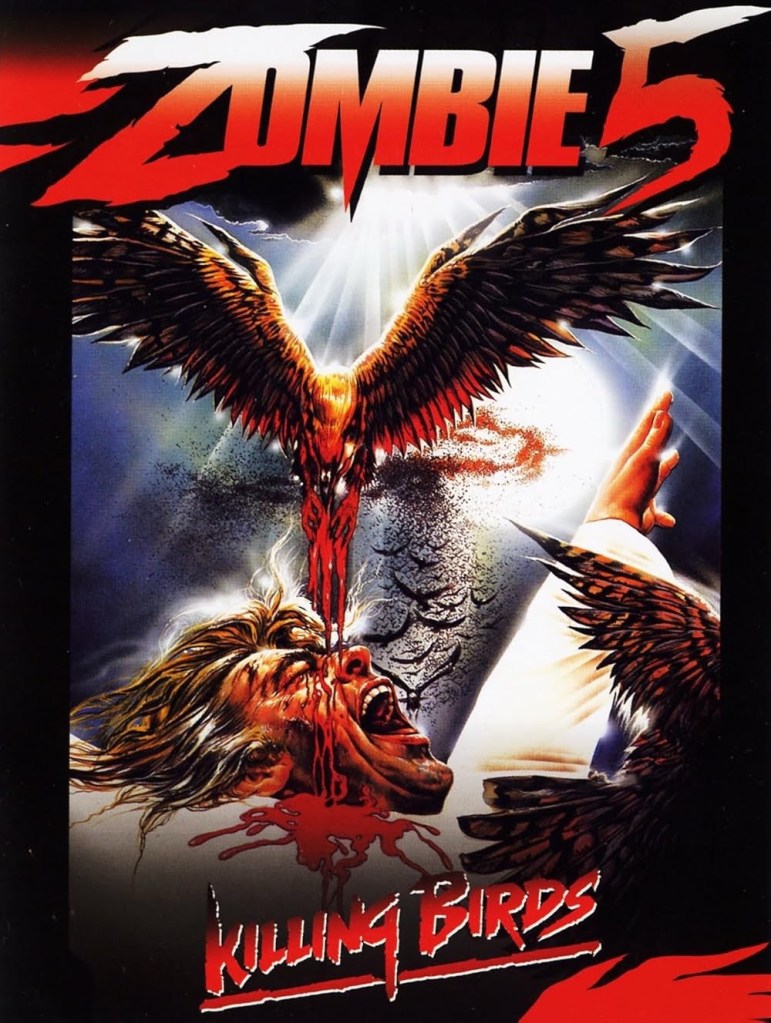
At this point, the Zombi “series” has completely drifted from whatever its original intentions were, and this entry is the clearest example of that. Despite the title, this isn’t really a zombie film at all — it plays more like a low-budget haunted house movie mixed with supernatural thriller and possession elements. The zombie label is clearly slapped on purely for marketing purposes.
The plot is all over the place. A soldier returning from Vietnam discovers his wife in bed with her lover and murders them along with a couple of friends, only to be attacked by a bird that blinds him. Years later, the bodies were never found, and the former soldier is now a bird specialist named Dr. Fred Brown, living near a swamp. When a group of college students arrive to research an almost-extinct species of woodpecker, they seek Dr. Brown’s help and end up staying in a nearby abandoned house where the murders occurred. Over the course of the night, they encounter strange supernatural events and “zombies” roaming the decaying property.
The film feels cheap, unfocused, and poorly put together. The acting is bad, the characters are completely forgettable, and there’s very little substance holding the story together. It lacks tension, atmosphere, and any real identity, making it a largely dull and ineffective watch. The only real standout is Robert Vaughn (Superman III, The Magnificent Seven), but even that comes with a caveat — he’s barely in the movie at all, appearing for maybe five to ten minutes.
Overall, this is a weak and forgettable entry that barely qualifies as a zombie film, let alone part of the Zombi lineup. It’s another example of how far the “series” fell by this point. I’d give it a 2 out of 10.
Rating: 2/10
20. Night of the Living Dead: Resurrection (2012)
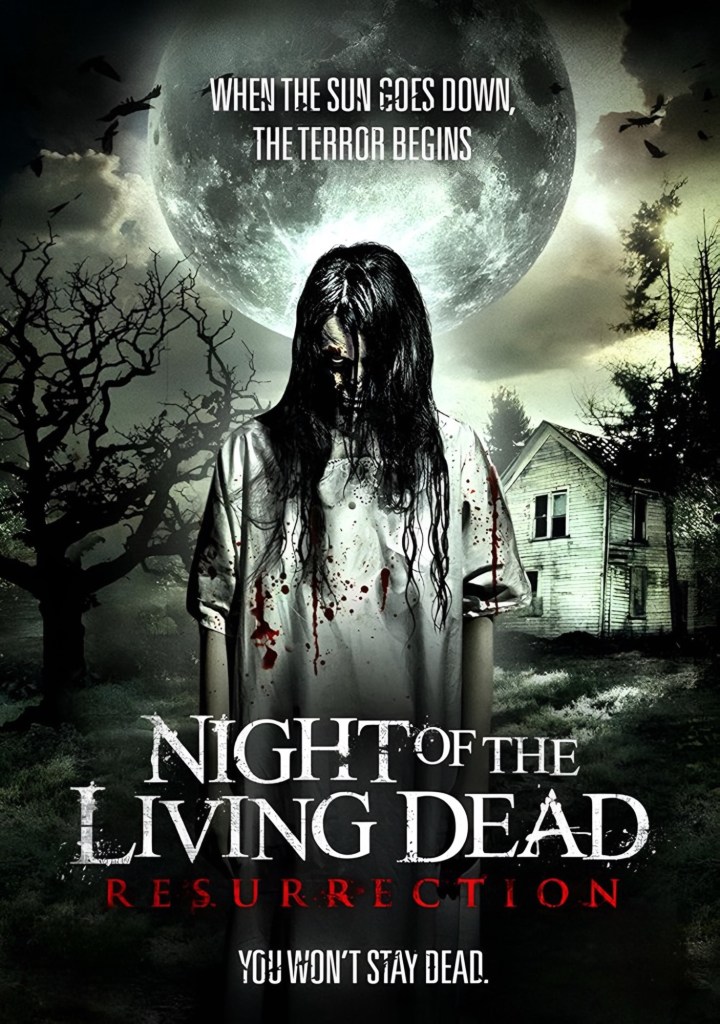
I guess the United Kingdom — specifically Wales — wanted in on the Night of the Living Dead cash-grab trend, because this is yet another unofficial straight-to-video stinker. The plot follows a familiar setup: in 2012, the dead rise from their graves with only one instinct — to feed on the living. As academics debate scientific explanations and theologians point to Armageddon from the Book of Revelation, civilization collapses. A family seeks refuge in an isolated farmhouse in West Wales, only to discover that the greatest threat may already be among them.
Unfortunately, the film is a plodding, tedious, and boring mess that feels more like a low-budget YouTube fan film than something that somehow received proper distribution. It genuinely plays like a community theater group decided to make a zombie movie and film it — which is oddly fitting, considering auditions were held at the Dylan Thomas Theatre in Swansea. The plot meanders endlessly, spending most of its runtime on people sitting around and talking. The acting is subpar, the effects are cheap, and the cinematography looks like it was shot on a basic consumer camera. It’s not good by any stretch, though it’s also not quite as offensively bad as some of the other entries I’ve watched. The best I can give it is a 2.25 out of 10.
Rating: 2.25/10
19. Night of the Living Dead 3D: Re-Animation (2012)
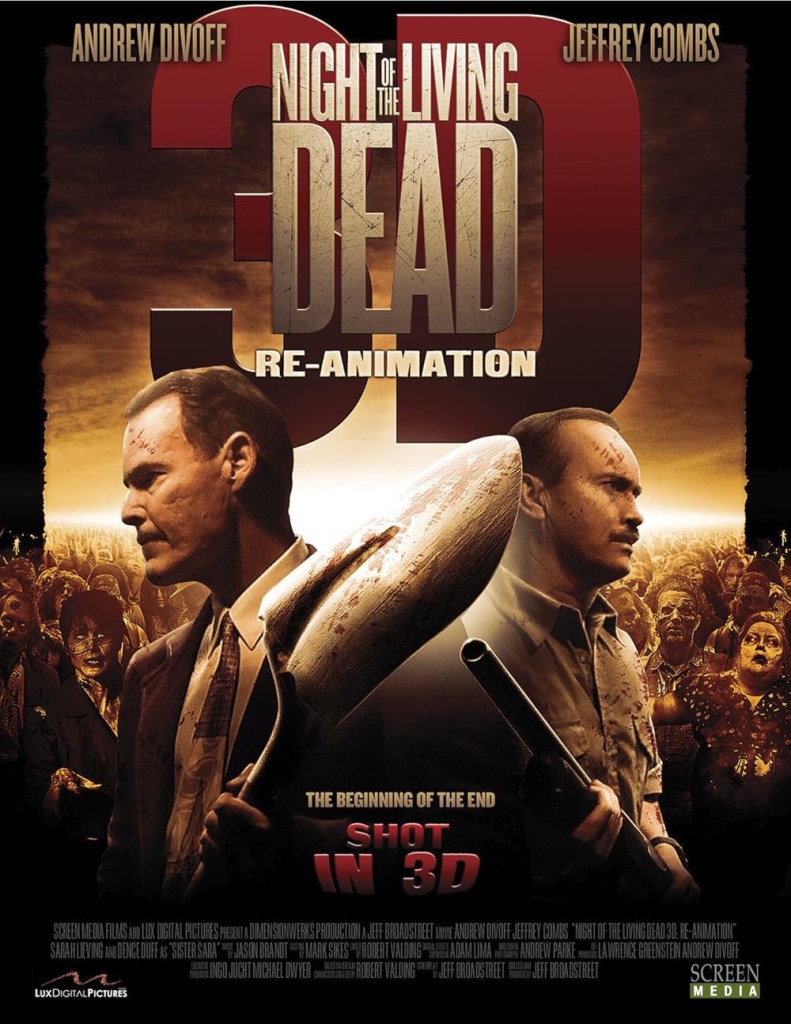
A prequel to Night of the Living Dead 3D, this film follows mortician Gerald Tovar Jr. after inheriting the Tovar & Son mortuary following his father’s death. Gerald is dissatisfied with his assistant DyeAnne, leading his Aunt Lou to hire Cristie Forrest as a replacement. When Gerald’s brother Harold visits, Gerald reveals that corpses delivered by the U.S. Army are reanimating, showing him a crematory filled with bodies and body parts. Harold believes Gerald has completely lost his mind and leaves, but soon after, Aunt Lou is bitten by a zombie, triggering an outbreak within the mortuary.
On paper, this actually sounds like it could’ve worked, especially with Andrew Divoff (Wishmaster) taking over Sid Haig’s role as Gerald Tovar Jr. and Jeffrey Combs (Re-Animator) playing his brother Harold. Unfortunately, the execution is anything but promising. This ends up being yet another shameless cash grab with a boring, meandering plot, uninteresting characters, and choppy editing. The makeup and effects are somehow even worse than the previous film, with painfully obvious green-screen work and laughable dummy effects that completely pull you out of the movie. The only real positives here are Divoff and Combs, and even then, this is far from their best work. Overall, it’s another forgettable entry that adds nothing of value, earning a 2.5 out of 10.
Rating: 2.5/10
18. Night of the Living Dead 3D (2006)
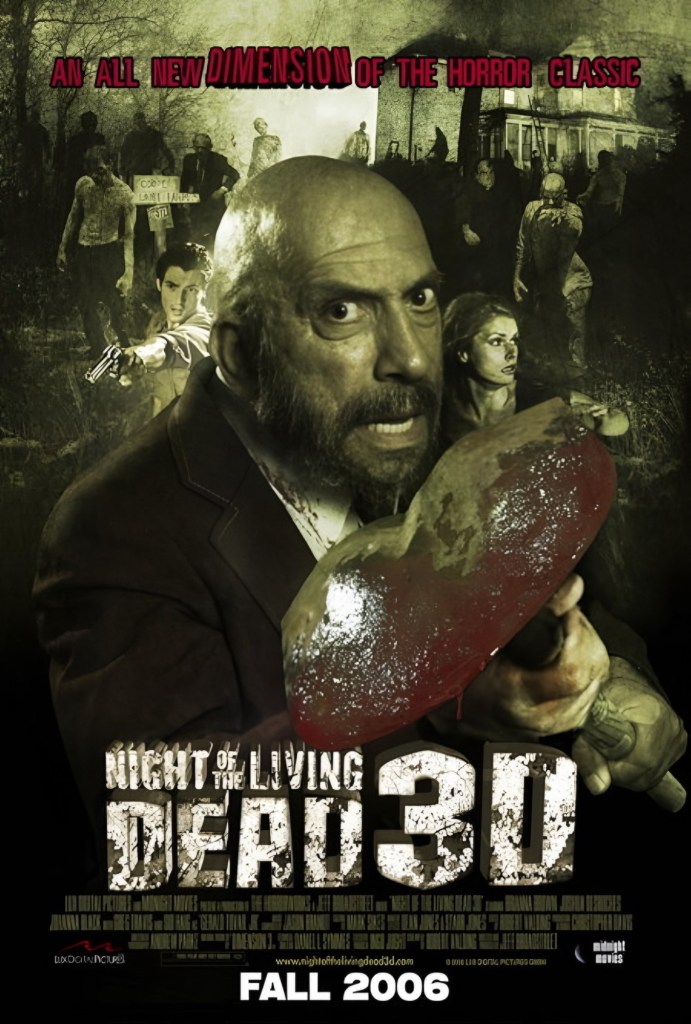
Being both a homage and a reimagining of the original 1968 film, we follow Barb and her brother Johnny as they arrive late for the burial of their aunt—only to walk straight into a nightmare. When zombies attack at the cemetery, Barb flees and is rescued by Ben, a local college student. The two take refuge in a nearby farmhouse occupied by the Cooper family, whose laid-back residents are completely unprepared for their lives to turn into a full-blown horror movie. But Barb is ultimately headed toward an even grimmer confrontation—with the pyrophobic mortician Gerald Tovar Jr.
By no means is this a classic like the original, and it’s absolutely a cheap, straight-to-video, unofficial cash-in. That said, compared to Children of the Living Dead and Day of the Dead 2: Contagium, it’s actually decent. It does what most remakes should do: pay homage to the original while at least attempting its own take on the material.
I personally enjoyed Brianna Brown and Sid Haig’s performances as Barb and Gerald Tovar Jr. respectively, and while the film is clearly low-budget and the plot could’ve used more work, the zombie makeup and effects were fairly solid for what they had to work with. It’s far from great, but it’s not an outright embarrassment either. Overall, I’d give it a 2.75 out of 10.
Rating: 2.75/10
17. Return of the Living Dead: Rave to the Grave (2005)
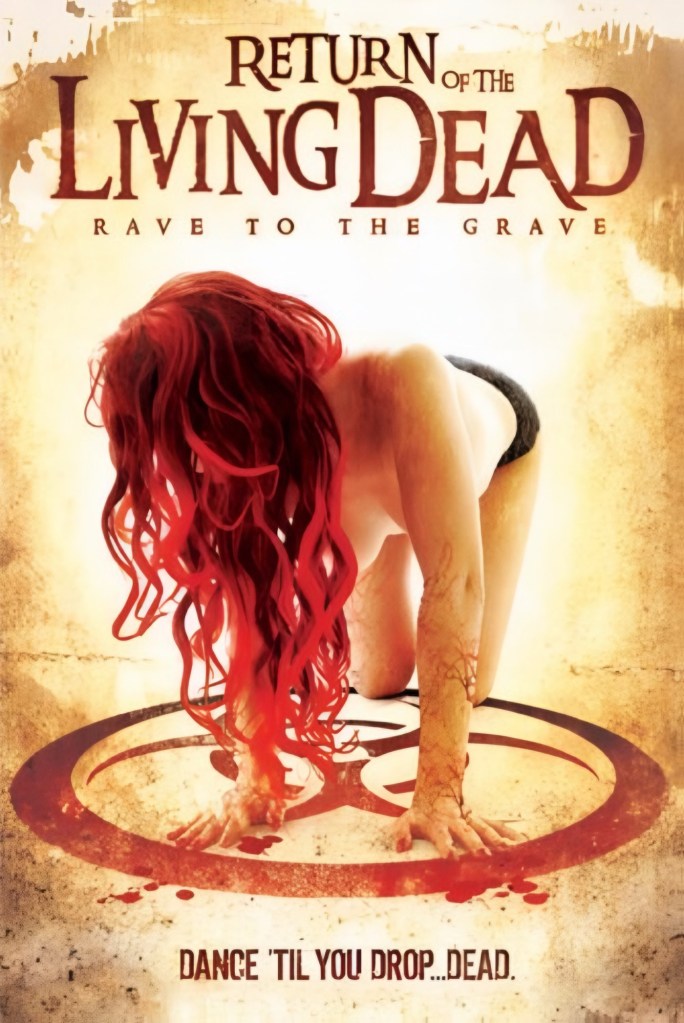
Set directly after Necropolis, the film opens with Charles Garrison arriving at a mortuary carrying a canister of Trioxin, where an Interpol operation meant to destroy the remaining supply goes horribly wrong, releasing the gas, reviving corpses, and killing Charles along with several others. It’s Halloween, and Julian, Jenny, Cody, and Becky — survivors from the previous film — are now in college when they learn of Charles’s death. While going through his belongings, Julian and Jenny discover two remaining barrels of Trioxin. Cody experiments with the chemical, which is mistakenly treated as a party drug called “Z,” leading students to ingest it at a rave. The substance rapidly turns users into zombies, sending the night into total chaos. Once authorities realize what’s happening, the military is called in and responds by bombing the rave, seemingly ending the outbreak, with Julian and Jenny surviving while the fate of others is left unclear.
Somehow this is worse than Necropolis. It suffers from the same bad script, poor acting, choppy editing, flat cinematography, and nonstop illogical decisions — only now it’s even more frustrating because several characters return knowing exactly what Trioxin does. Watching them willingly mess with it, turn it into drugs, and ignore everything they experienced before makes absolutely no sense. It’s a miserable way for The Return of the Living Dead franchise to go out. The only positive I can give it is the return of the Tarman zombie, even if he looks incredibly cheap this time around. It’s a 3 out of 10.
Rating: 3/10
16. Zombi 3 (1988)
AKA Zombie 3, Zombie Flesh Eaters 2
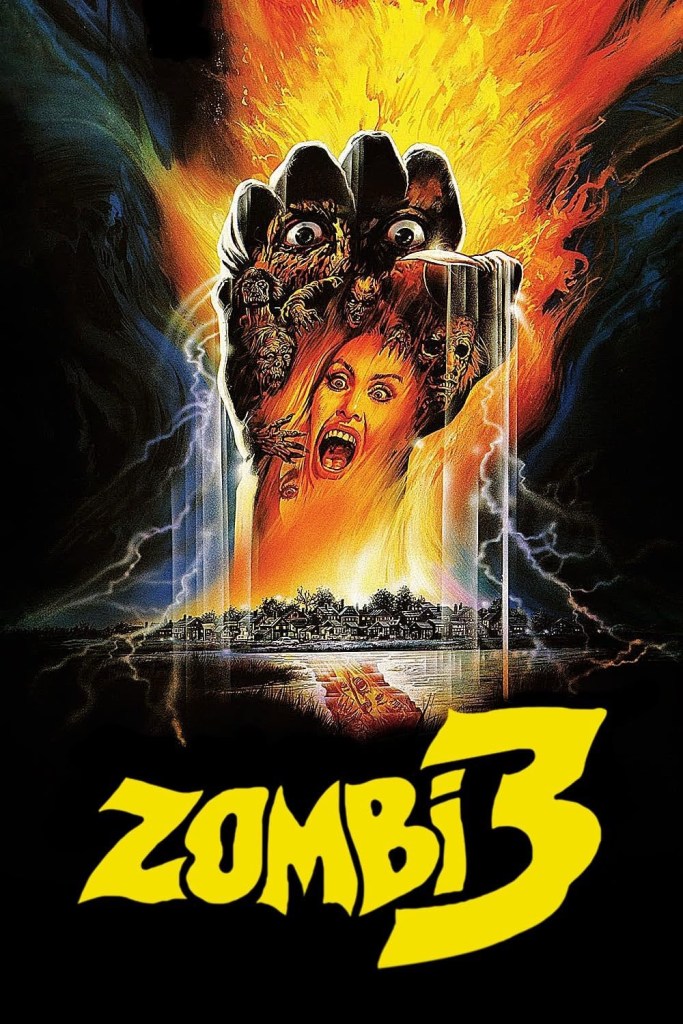
Zombi 3 had potential on paper, largely because Lucio Fulci was originally attached to return. Unfortunately, due to serious health issues, Fulci was forced to leave the project early in production, with Bruno Mattei and Claudio Fragasso (yes, that Claudio Fragasso of Troll 2 and Night Killer infamy) stepping in to finish the film. That behind-the-scenes chaos is immediately evident, as the final product feels disjointed, inconsistent, and unsure of what it wants to be.
The plot is once again extremely thin and mainly exists as a loose framework to jump from one set piece to another. A terrorist’s body infected with a stolen chemical weapon is recovered by the U.S. military and cremated, accidentally releasing the virus into the atmosphere over a small island. Soon after, the infected population begins mutating into flesh-hungry zombies. A group of soldiers on leave teams up with stranded tourists, and they barricade themselves inside an abandoned hotel in an attempt to survive the outbreak.
Compared to Zombi 2, this film feels noticeably cheaper and more scattershot. The gore is toned down, the effects are weaker, and the atmosphere never fully clicks. While there are a few entertaining moments — such as zombies wielding weapons, zombified birds attacking people, and a bizarre scene involving a zombie head flying out of a refrigerator — these moments feel isolated rather than part of a cohesive whole.
The characters are especially forgettable. Unlike Zombi 2, where at least the central group had some presence, here it’s difficult to even remember names or personalities. There’s very little emotional investment, which makes the constant jumping between action beats feel hollow.
Overall, Zombi 3 is a clear step down from Zombi 2. While it has a handful of amusing ideas, it’s ultimately a messy, unfocused, and forgettable entry that highlights the dangers of a troubled production. It’s not without minor entertainment value, but it lacks the atmosphere, impact, and memorability of its predecessor. I’d give it a 3.25 out of 10.
Rating: 3.25/10
15. Zombi 4: After Death (1989)
AKA After Death (Oltre la morte), Zombie Flesh Eaters 3

Claudio Fragasso returns to direct this one, but true to the Zombi “series,” it’s another cheap and cheesy entry with a thin plot. These aren’t the same types of zombies we saw before; now we’re dealing with voodoo-cursed undead. The story follows a woman returning to the island where her parents were killed years earlier. Her parents had been working on a cure for cancer and accidentally angered a voodoo priest, raising the dead. She joins a group of mercenaries and meets up with some researchers, only to trigger another wave of undead chaos.
Once again, the characters are forgettable and mostly uninteresting, though the effects and makeup are solid. The film has that 1980s action-movie charm blended with horror, and I actually enjoyed the soundtrack — especially the main theme, “Living After Death” by Al Festa. Overall, I found this entry more enjoyable than Zombi 3 and Zombi 5, but it still doesn’t hold a candle to Zombi 2. I’d give it a 3.5 out of 10.
Rating: 3.5/10
14. FleshEater: Revenge of the Living Dead (1988)
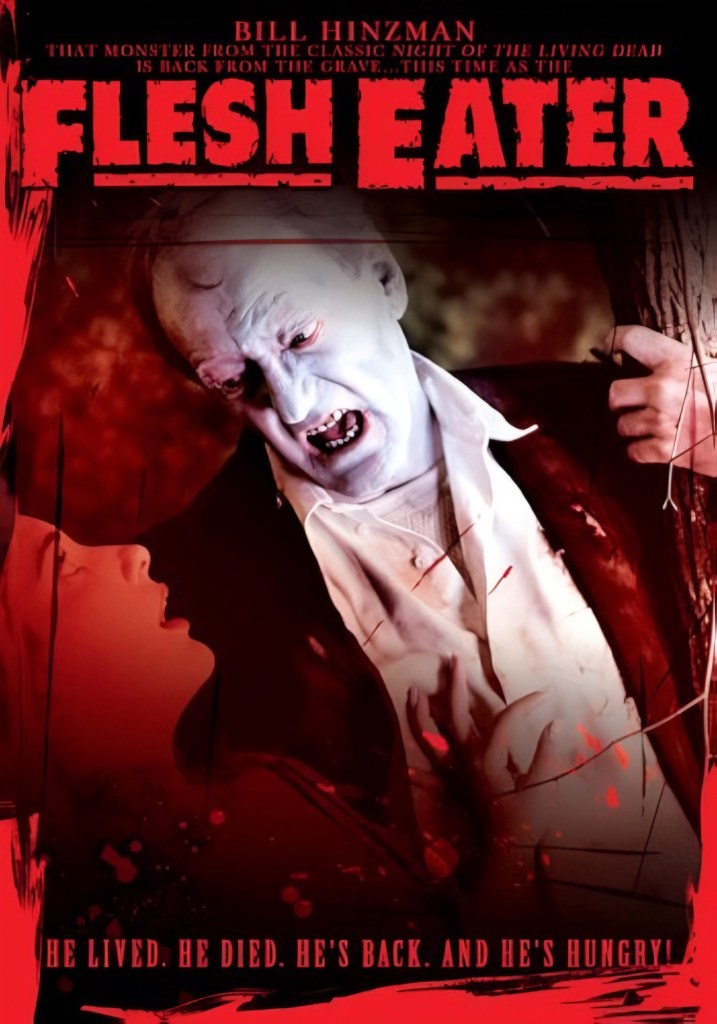
Written, directed, and starring S. William Hinzman — best known as the cemetery zombie in Night of the Living Dead — we get FleshEater: Revenge of the Living Dead. The title was taken from one of the original working titles for Night of the Living Dead (Night of the Flesheaters), and the film essentially plays as an unofficial spinoff, sequel, or companion to Romero’s classic, even hitting a few similar beats and being shot in rural Pennsylvania.
The story follows a group of teenagers on an overnight hayride on Halloween who stumble upon the grave of a man — only to discover he’s a zombie. One by one, the living fall victim and turn into zombies, leaving the survivors to fight for their lives while trying to escape and warn the authorities.
Like many low-budget indie horror films, it suffers from forgettable characters, a thin plot, and a very amateurish feel. That said, it has a certain charm reminiscent of Night of the Living Dead, though with more gore, nudity, and the B-movie style of 1980s horror. Overall, it is what it is: a direct-to-video amateur effort. The charm only goes so far, as bad acting, sloppy editing, and the obvious cash-grab nature of the project hold it back. I’d give it a 3.75 out of 10.
Rating: 3.75/10
13. Day of the Dead: Bloodline (2017)
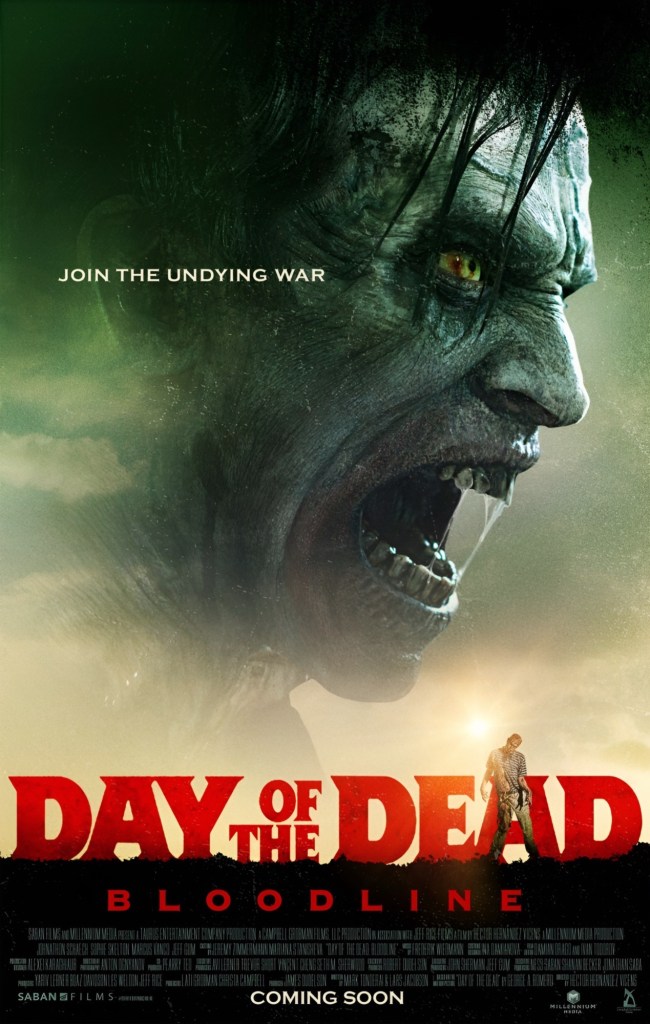
Compared to the other Day of the Dead remakes, this is easily the closest to the original, albeit with a few modern twists. The story follows Zoe Parker, a reluctant medical student who survives the initial outbreak of a zombie-like plague after an attack by her obsessive patient Max coincides with the dead reanimating and overrunning her city. Five years later, Zoe is working as a doctor in the isolated High Rock Emergency Bunker, where she believes Max’s unusual blood could be the key to a cure, despite the skepticism of the hardened commander Miguel Salazar.
A supply run to a university quickly spirals into chaos when Max—now partially transformed—reappears and infiltrates the bunker, escalating tensions and proving the threat isn’t just outside the walls. As casualties pile up and Zoe’s friend Elyse is killed to prevent infection, Zoe races to develop a vaccine using Max’s blood. Things fully collapse when Max unleashes a rotter horde, killing many—including Miguel—before Zoe finally puts him down herself. In the aftermath, Zoe successfully cures her bitten boyfriend Baca, restores the bunker, and broadcasts a message of hope to surviving humanity, even as the undead still linger beyond the gates.
Unfortunately, the execution really drags this down. The acting often feels like daytime soap-opera levels of bad, the cinematography is flat and lifeless, the dialogue is clunky, and character decisions frequently make no sense. Max in particular is an exhausting, unnecessary presence, and centering so much of the plot around this sex-pest villain was a bad call. While it’s not the worst Day of the Dead remake and at least tries to echo Romero’s themes, the flaws outweigh the positives. Overall, it lands at a 4 out of 10.
Rating: 4/10
12. Return of the Living Dead: Necropolis (2005)
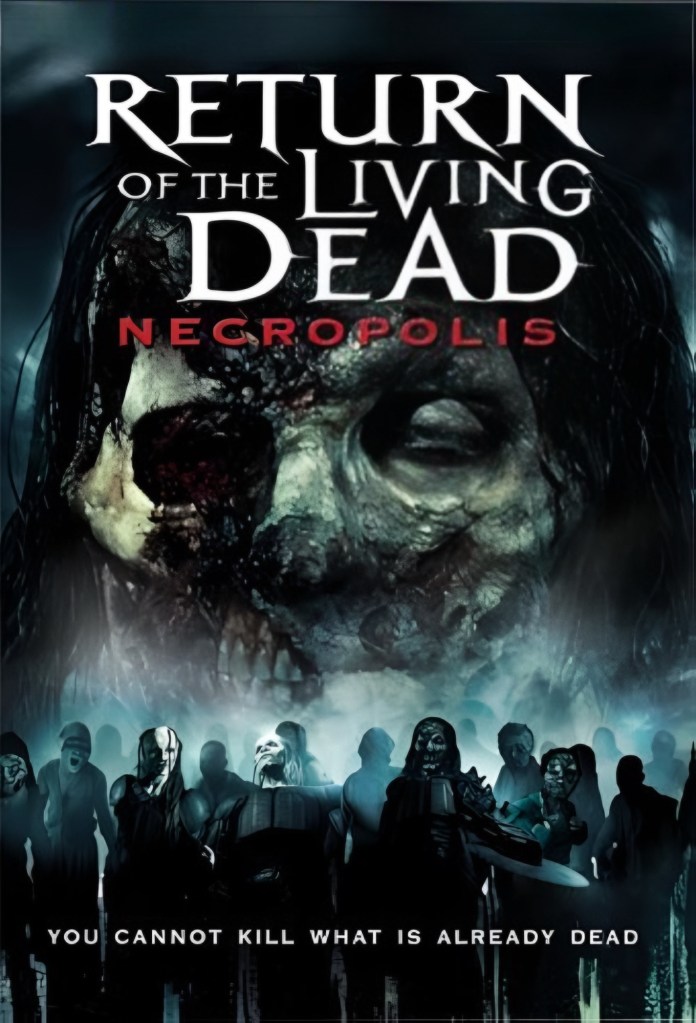
We’re firmly in direct-to-video/Sci-Fi Channel schlock territory now. Set ten years after Return of the Living Dead III, the film follows Julian Garrison, whose uncle Charles is secretly experimenting with Trioxin recovered from Chernobyl at the Hybra Tech facility. When Julian’s friend Zeke dies in a motorcycle accident and is taken to Hybra Tech, Julian and his friends break into the complex to rescue him, only to discover rooms full of zombies and grotesque military experiments — including Julian’s parents, now weaponized undead soldiers. As Trioxin leaks and the facility erupts into chaos, zombies overrun the building, killing several members of the group while others flee through vents and corridors. The survivors are hunted by both standard zombies and Julian’s heavily armed undead parents, leading to explosive confrontations and tragic deaths, before a SWAT team wipes out the remaining horde. Of course, Charles escapes with more Trioxin, and the outbreak is covered up, implying the cycle continues.
This isn’t a good film by any means, and it gets so much wrong — from stupidly changing what made the zombies and Trioxin unique by making them killable like standard zombies, to turning the whole thing into a bargain-bin Resident Evil knockoff with Hybra Tech standing in for Umbrella. The script is weak, the acting is poor, the editing is choppy, the cinematography is flat, and the continuity barely holds together. At its most basic, it’s just high schoolers vs. zombies, and I’m not sure who that’s supposed to appeal to. Even director Ellory Elkayama admitted he only took this and Rave to the Grave for the paycheck, had no control over the script, and wishes he could forget the experience entirely — which honestly says it all. It’s a 4.25 out of 10.
Rating: 4.25/10
11. Return of the Living Dead III (1993)
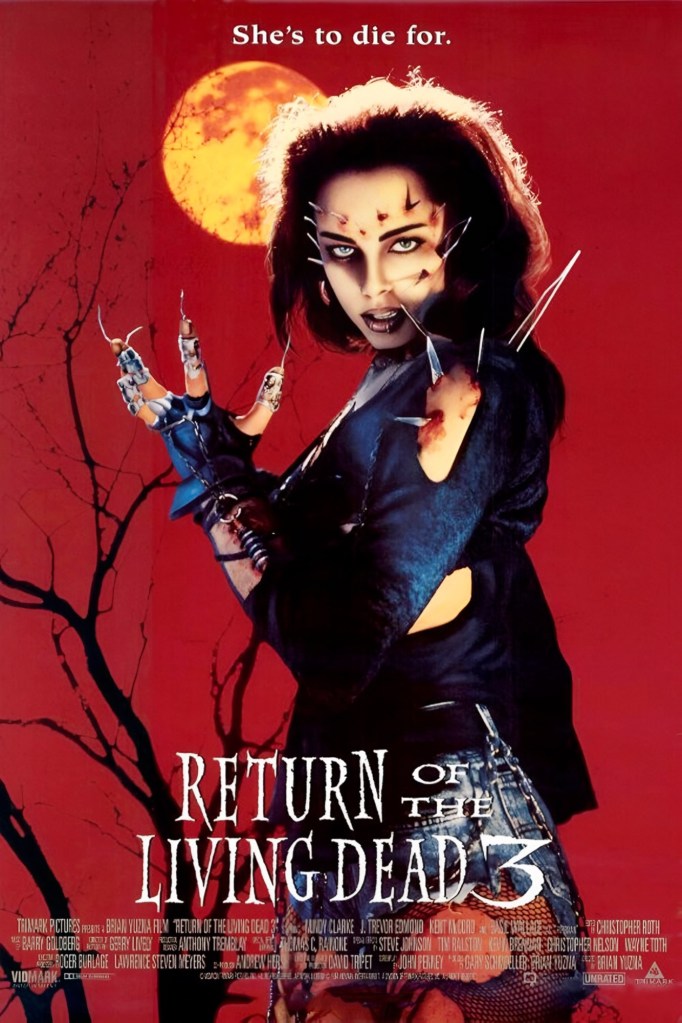
Written by John Penney and directed by Brian Yuzna, and taking place five years after the previous film, Return of the Living Dead III follows teenager Curt Reynolds, who sneaks into a military base with his girlfriend Julie, where the U.S. Army is experimenting with Trioxin in an attempt to weaponize zombies. When a test inevitably goes wrong and the undead prove uncontrollable, Curt’s father is removed from the project. After Curt and Julie flee, a motorcycle crash kills Julie, prompting Curt to secretly revive her using Trioxin. The two go on the run as Julie struggles with an overwhelming hunger for brains, leaving a trail of death behind them. Hiding in the sewers, Julie discovers that extreme pain temporarily suppresses her cravings, leading her to mutilate herself in a disturbing act of self-control. As gangs and the military close in, chaos erupts back at the base, Curt is bitten, and realizing there’s no escape—and that Julie will be used as a weapon—he chooses to stay with her. The film ends with the two dying together in a furnace, giving the story a tragic, fiery conclusion.
Tonally, the film leans much darker than Part II, blending romance and horror with light comedic touches while adopting a very angsty ’90s vibe. Unfortunately, it’s not all that interesting overall, with an uninspiring plot that focuses too heavily on rebellious teen romance, inconsistent zombie behavior, cheap-looking effects, and painfully obvious sets. That said, Melinda Clarke is easily the standout of the film, and in some ways this feels closer to the original than Part II ever did. Still, by this point—aside from brief references to earlier entries and the continued use of 2-4-5 Trioxin—the series is far removed from what made The Return of the Living Dead special in the first place. It’s a 4.5 out of 10.
Rating: 4.5/10
10. Return of the Living Dead Part II (1988)
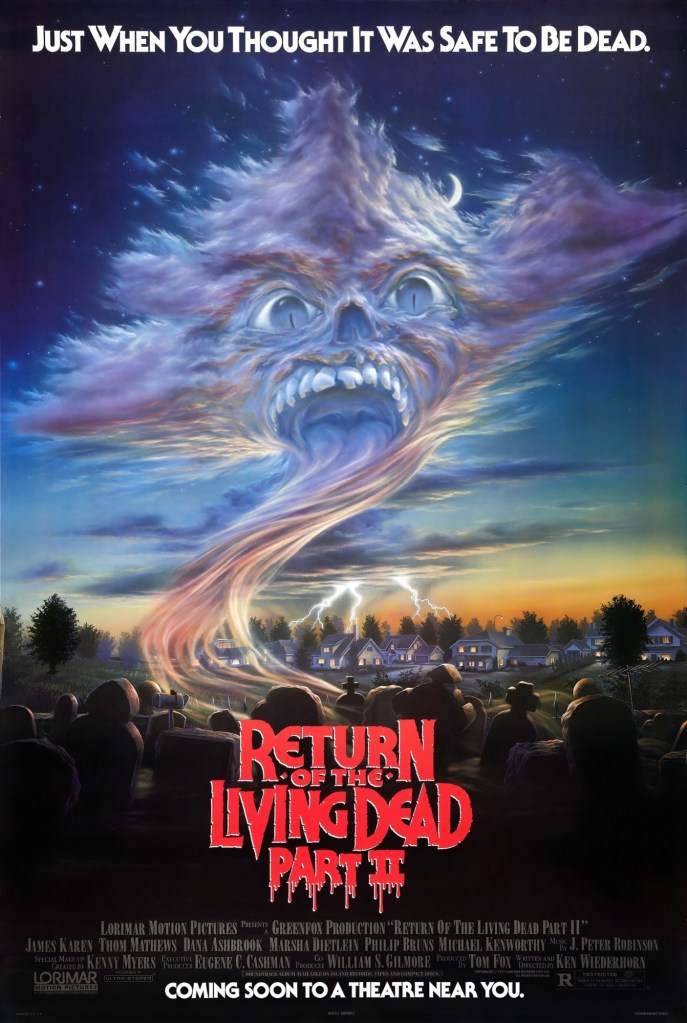
Dan O’Bannon and John Russo didn’t return for this one, and it shows, with Ken Wiederhorn stepping in as both writer and director. This feels like a lesser remake of the original, hitting many of the same plot beats and gags but leaning far more into comedy than horror. Clearly aimed at kids and teens, it features child protagonists, a goofier tone, slapstick humor, cheap makeup and effects, toned-down gore, and none of the punk, sex, and drugs edge that gave the original its rebellious energy — not to mention the loss of the legendary punk soundtrack. The plot follows a U.S. military truck accidentally losing a barrel of Trioxin into a river, which pre-teen bullies Johnny and Billy stumble across while initiating Jesse Wilson into their club. The chemical leaks, corpses rise, and acid rain spreads the contamination. As chaos erupts, the survivors—including Jesse, his sister Lucy, and grave robbers Ed, Joey, and Brenda—flee through hordes of zombies. They lure the undead to a power plant to electrocute them, and only Jesse survives, defeating Billy as the military arrives to contain the aftermath. A positive is seeing James Karen and Thom Mathews return in familiar roles, but overall this feels more like a TV movie or an extended episode of Goosebumps — too kid-friendly and cheap-looking, a drastic shift from the original. It’s a 4.75 out of 10.
Rating: 4.75/10
9. Zombi 2 (1979)
AKA Zombie, Zombie Flesh Eaters
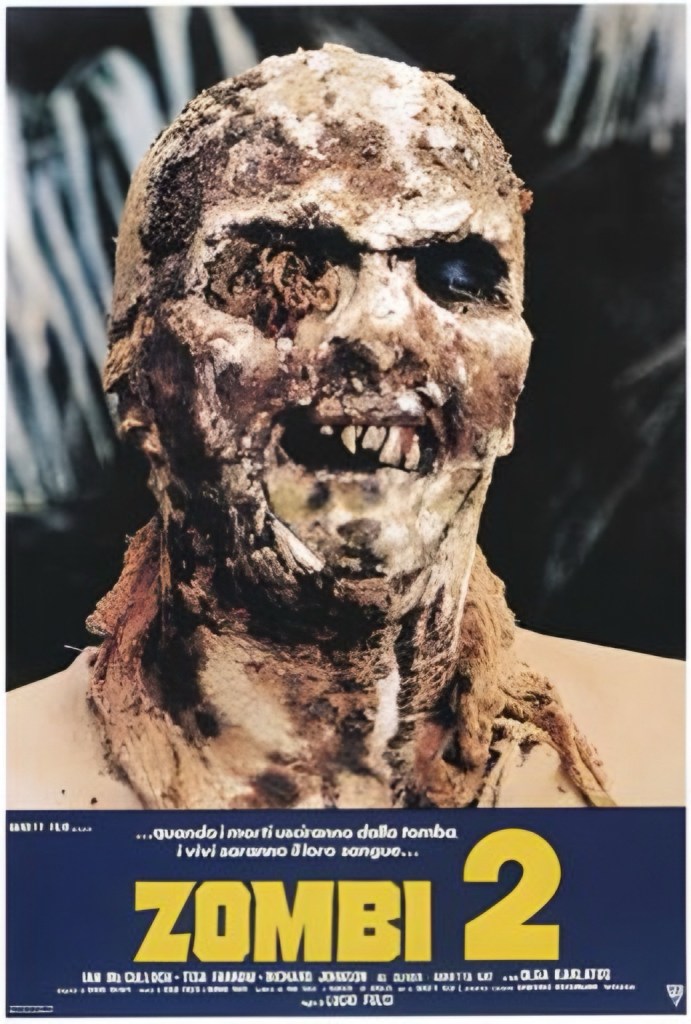
Before getting into the review, it’s important to explain just how confusing the Zombi series actually is. Dario Argento co-produced Dawn of the Dead and held the European distribution rights, where it was retitled Zombi. Years later, Lucio Fulci made Zombie, but Italian distributors renamed it Zombi 2 to capitalize on the success of Zombi. This practice continued for several more films, meaning this “series” isn’t a connected narrative at all — it’s purely a marketing tactic designed to exploit the Italian audience.
The plot itself is fairly thin. A sailboat arrives in New York harbor with no living crew, except for a zombie that attacks two Coast Guard officers. Anne Bowles, the daughter of the ship’s owner, seeks answers about her missing father, who had been traveling in the Antilles. When the investigation goes nowhere, she teams up with journalist Peter West, and together with Brian Hull and Susan Barrett, they travel to Matul Island. There they encounter Dr. David Menard, who is attempting to understand — and possibly cure — a mysterious disease that causes the dead to rise and feast on the living.
The film meanders quite a bit narratively, but what really carries Zombi 2 is its atmosphere, visuals, and extreme gore. Fulci’s effects are gruesome, memorable, and often shocking even by today’s standards. Iconic moments like the infamous eye-stabbing scene and the absolutely absurd zombie-versus-shark fight have cemented the film’s cult reputation. These sequences are the main reason the movie is still talked about.
Overall, Zombi 2 is a classic primarily because of its gore, imagery, and unsettling tone rather than its story. It’s a shame the narrative isn’t stronger, as that’s what ultimately holds the film back for me. Still, for its atmosphere and effects alone, it earns its place in zombie cinema history. I’d give it a 5 out of 10.
Rating: 5/10
8. Day of the Dead (2008)
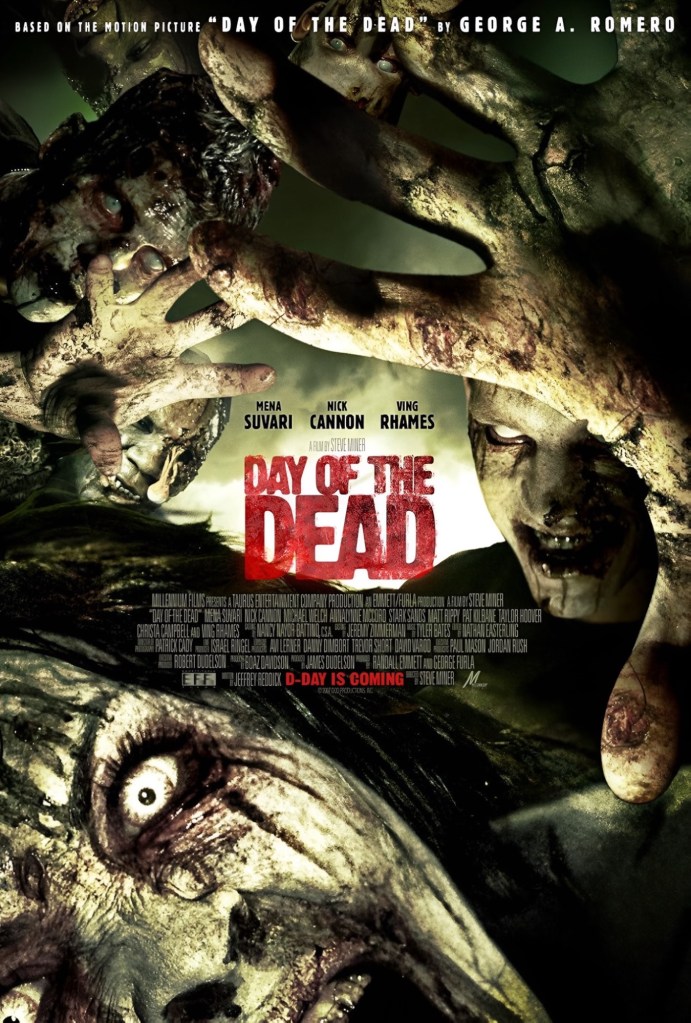
A remake in name and character names only, this shares very little with the original. The plot follows events in Leadville, Colorado, where Captain Rhodes and his unit seal off the town to contain an influenza-like epidemic. The locals aren’t allowed to leave, and the Pine Valley Medical Center quickly becomes overwhelmed with sick residents. Corporal Sarah Bowman, who grew up in Leadville, returns home with Private Bud Crain to visit her mother, only to discover she’s ill as well. When the infected suddenly turn into fast-moving, flesh-eating zombies, chaos erupts. Sarah, Bud, and Private Salazar attempt to escape, but after hearing her brother Trevor’s voice over the radio, Sarah diverts to rescue him and his girlfriend Nina. The group eventually seeks refuge at an isolated Nike missile site, uncovering an underground army base in the process.
Written by Jeffrey Reddick (Final Destination) and directed by Steve Miner (Friday the 13th Part 2 & 3), this honestly isn’t a bad film — but it’s not a great one either. It’s a serviceable straight-to-video zombie movie with a fairly solid cast, though some of the choices are a bit questionable, including Mena Suvari (American Pie), Ving Rhames, Nick Cannon, and Michael Welch (Mack from Z Nation). The plot is cliché and very much your standard zombie setup, but I didn’t really mind since the action and gore were decent, and it mostly works as a standalone film.
I also didn’t completely hate this new take on the zombies. They’re fast, aggressive, and have some supernatural flair — climbing walls and moving with inhuman agility — although at times the CGI is way too heavy-handed. The whole “vegan zombie buddy” angle was pretty dumb, though. Still, for what it is, it’s the kind of movie you’d stumble across while scrolling through Netflix late at night, put on, and not regret watching. I was entertained, and I’d probably revisit it again someday. Overall, it’s a 5.25 out of 10.
Rating: 5.25/10
7. Night of the Living Dead (1968)
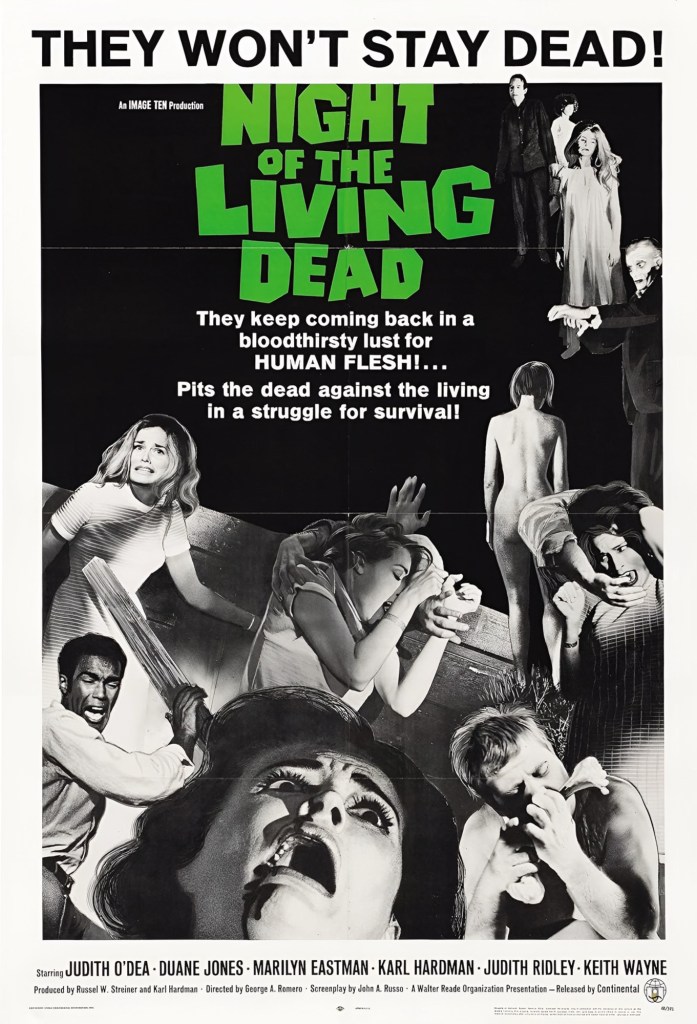
Written by John A. Russo and George A. Romero and directed by Romero, Night of the Living Dead is the film that launched an entirely new era of horror and redefined what a “zombie” even was. Before this, cinematic zombies were rooted in voodoo, hypnosis, or mind control — nothing like the flesh-eating, mindless ghouls that have since become the genre standard. With this movie, Romero didn’t just make a low-budget shocker; he created a brand-new subgenre.
It also set the pattern for the social commentary that would define all of Romero’s later Dead films, though in this case the commentary was purely accidental. Many viewers now read the film as a racial statement because of Duane Jones’s casting as Ben, but the role was never written with race in mind. Romero clarified this repeatedly: “We didn’t think of the racial issue at all. Duane was just the best actor who came in,” and, “It wasn’t written for a Black actor. It became about race because of the times, not because we intended it.” Any racial resonance comes from the social climate of the late 1960s rather than deliberate design.
For me, the real thematic core of the film lies in its depiction of distrust, mob mentality, and the collapse of social order. The movie is undeniably important to horror history and a strong first entry, but I don’t think it’s the best in the franchise. Much like the original Friday the 13th, its legacy is more significant than its individual strengths. Overall, I’d give it a 5.5 out of 10.
Rating: 5.5/10
6. Dawn of the Dead (2004)
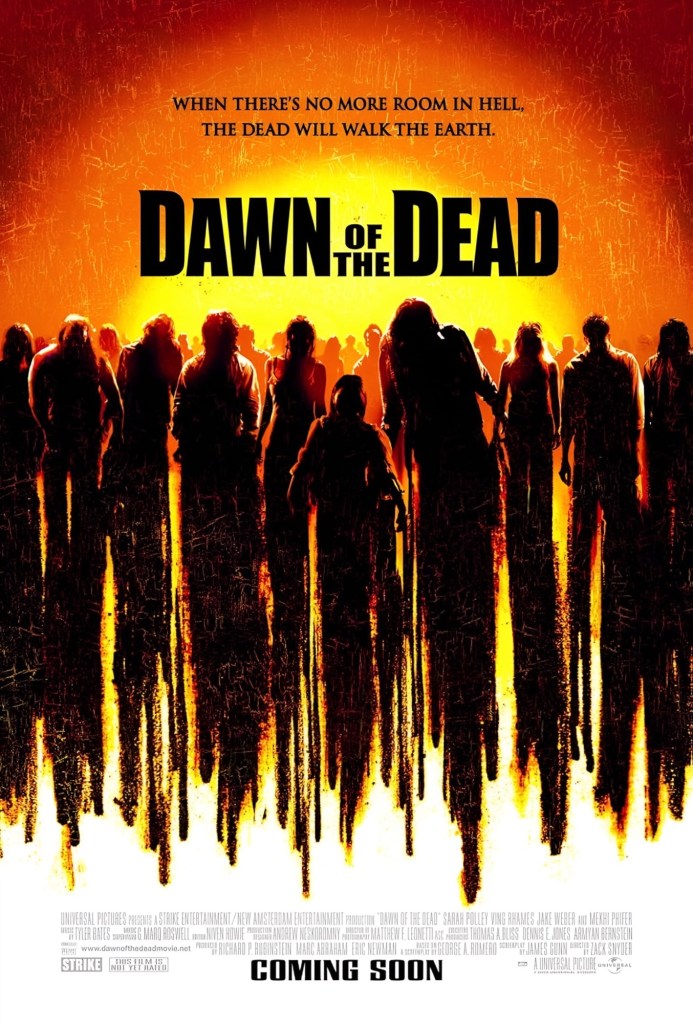
The feature directorial debut of Zack Snyder, written by James Gunn, this is one of the better horror remakes in a sea of bad ones. It arguably has one of the best openings of any zombie film, starting with a slow burn before exploding into all-out chaos, leading into those unforgettable opening credits set to “The Man Comes Around” by Johnny Cash. The plot largely follows the original with a few creative tweaks from Gunn and Snyder: set in Milwaukee, Wisconsin, we follow a nurse, a policeman, a young married couple, and other survivors of a worldwide plague that creates aggressive, flesh-eating zombies as they take refuge in the Crossroads Mall. As a Wisconsinite, this is a minor nitpick, but there is no Crossroads Mall in Milwaukee, and the locations look nothing like the area — which makes sense since most of the film was shot in Ontario, Canada, and parts of California.
I really enjoyed the core cast of nine — Sarah Polley, Ving Rhames, Mekhi Phifer, Jake Weber, Inna Korobkina, Bruce Bohne, Michael Kelly, Kevin Zegers, and Michael Barry — but once the film moves away from them around the 40–45 minute mark and introduces Ty Burrell and several other uninteresting characters, it kind of loses me. It should’ve stuck closer to the original and focused primarily on that core group. That said, it was great seeing cameos from the original Dawn of the Dead cast, with Tom Savini as the sheriff, Scott Reiniger as the general, and Ken Foree as the televangelist delivering his iconic line: “When there is no more room in hell, the dead will walk the earth.”
It may sound like I didn’t like this film, but I really do, especially when it comes to horror remakes. However, as a Dawn of the Dead remake, it leans far more into action than horror, feels overcrowded with forgettable characters, and includes some truly goofy elements like the bloated zombie woman and the awful CGI zombie baby. I’m also not a fan of the bleak, hopeless ending, where the survivors’ goal of reaching the island ends with them all dying anyway — another nitpick being that Wisconsin doesn’t really have many habitable islands on Lake Michigan or Superior, with Washington Island being the only logical option.
Overall, I still enjoyed the film quite a bit, especially Ving Rhames, Sarah Polley, and Jake Weber, and I did like the fast-paced zombies, which feel closer to the infected from 28 Days Later. Honestly, this is one of only three Zack Snyder films I actually like, the others being 300 and Watchmen — sorry, Snyderbros, his DC run wasn’t that good, and Army of the Dead and Rebel Moon were beyond horrible. It’s a solid 6 out of 10.
Rating: 6/10
5. Land of the Dead (2005)
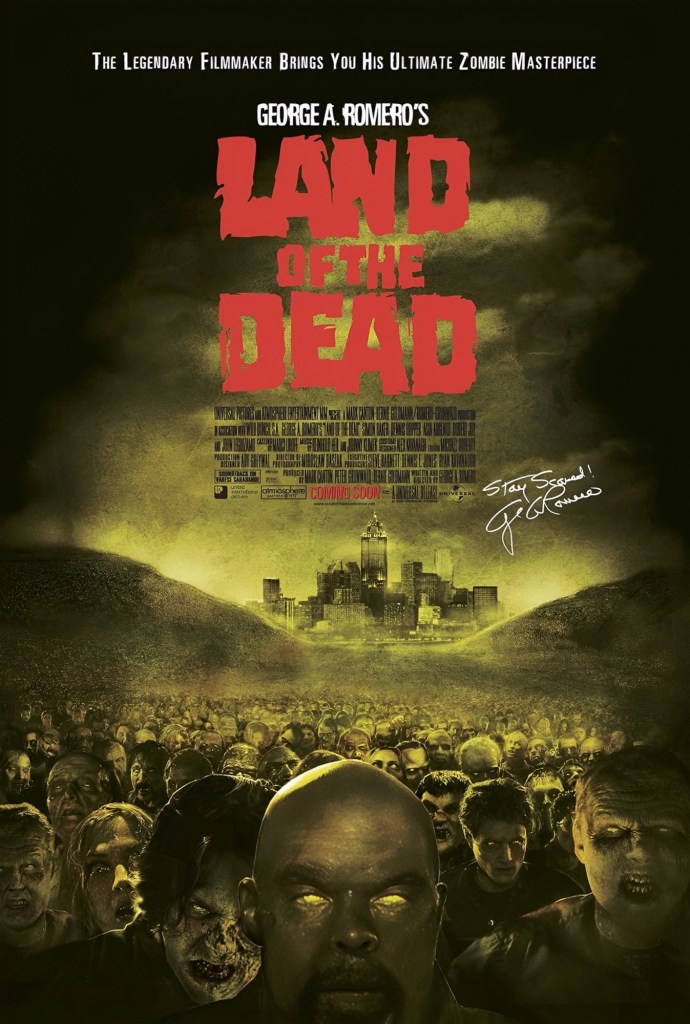
I think this is a pretty good film. It may not be quite on the level of the original trilogy, but I still liked it and honestly feel it’s underrated. Hardly anyone talks about it, even though it has a great cast with John Leguizamo, Simon Baker, and Dennis Hopper. Because of the cast and the tone, I always assumed this came out in the late ’90s or early 2000s, but it fits firmly into Romero’s 2000s social-commentary style.
The social themes here are very clear and straightforward: class division, political corruption, and wealth inequality. Romero lays it out visually — the zombies as the oppressed lower class, the survivors as the working class trying to get by, and the rich still living comfortably in a walled-off city with a luxurious high-rise tower. The elite are led by Kaufman (Hopper), who plays another great villain in this franchise: greedy, cold-hearted, and completely self-interested.
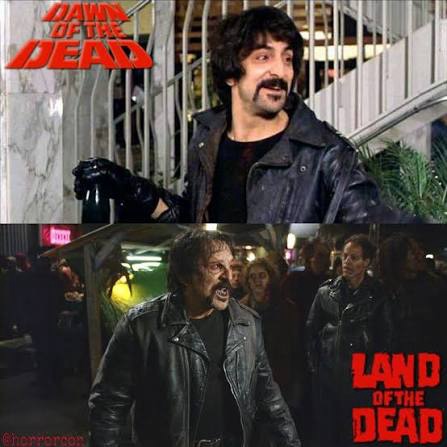
As for the heroes, I didn’t mind Riley, Slack, Charlie, or Cholo. They aren’t as memorable as the casts in the earlier films, but they work well enough to carry the story. And when it comes to the zombies, you really have to go back to Day of the Dead and Bub. Bub showed the first spark of evolved intelligence, and in this film the undead take the next step — with Big Daddy leading an entire army of zombies. It was also a fun touch to see Tom Savini’s biker character from Dawn of the Dead pop up again as one of the undead during the final battle.
Overall, it’s an easy 6.5 out of 10. I really wish more people talked about this movie, but at the same time I understand why it might not be everyone’s cup of tea.
Rating: 6.5/10
4. Day of the Dead (1985)
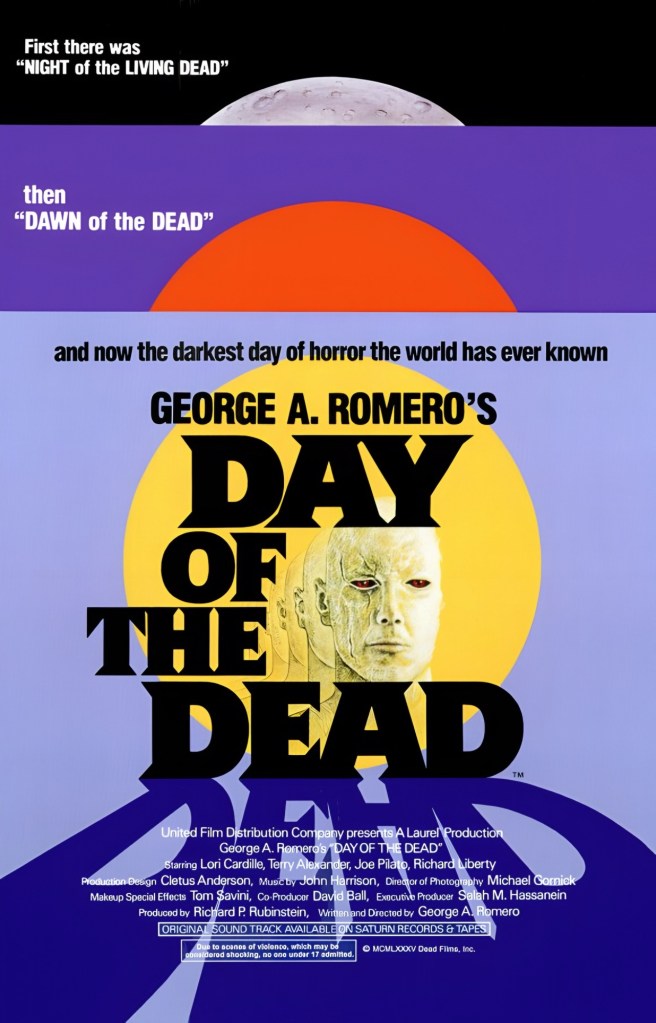
Romero is back at it again with the darkest and most oppressive entry in the franchise, exploring themes of authoritarianism, militarization, and the ethical limits of science. Taking place almost entirely in an underground bunker in Florida, the film feels claustrophobic and isolated as a small group of scientists and military personnel gradually fall apart. Tension builds and eventually explodes due to miscommunication, paranoia, and total distrust between the two groups.
The characters here are solid, with Sarah, John, and McDermott serving as decent protagonists, though I didn’t connect with them the way I did with the cast of Dawn of the Dead. The standout is Captain Rhodes — one of those great villains you absolutely love to hate — and among his many lackeys, Private Steel is at least entertaining. One of the film’s strongest elements is Bub, a zombie who shows memory, recognition, and intelligence. It suggests the undead are evolving to a whole new level, though Romero has hinted at this before: in Night, the ghouls were smart enough to use objects as weapons, and in Dawn, the zombies were drawn back to the mall out of lingering memories and routine.
Overall, I really enjoyed Day of the Dead, but where Dawn blended seriousness with humor, this film leans entirely into a mean-spirited, bleak, and suffocating tone. Because of that, it never quite reached the same level for me. Still, it’s a strong entry in the series, and I’d rate it a 6.75 out of 10.
Rating: 6.75/10
3. Night of the Living Dead (1990)
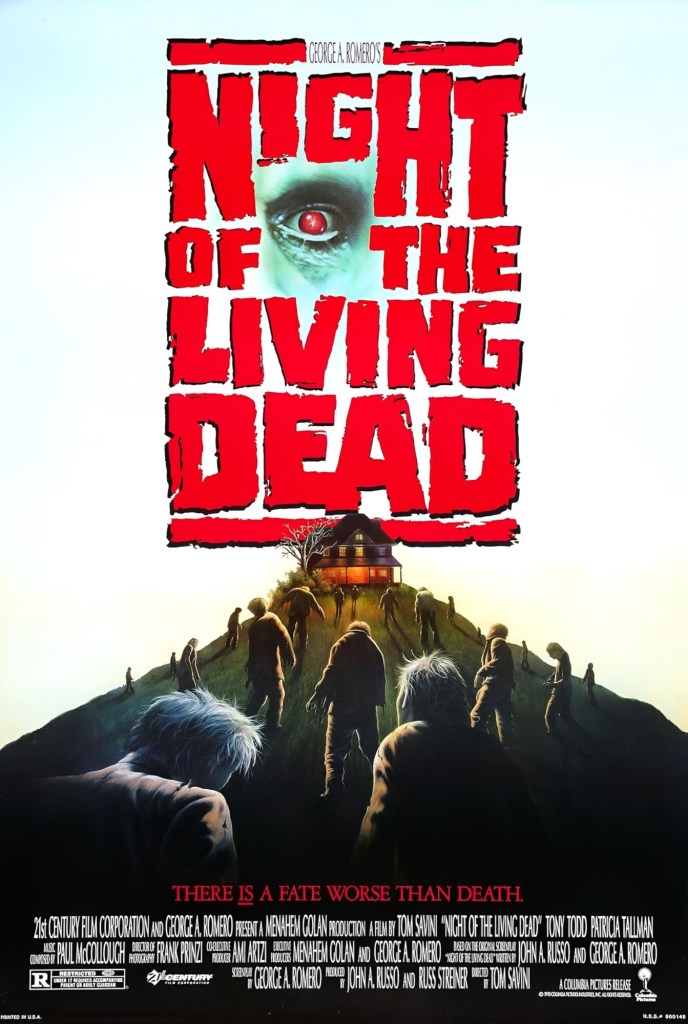
Wow, this was my first time finally seeing this film. I’ve been meaning to watch it for years but never got around to it until now, and after hearing for so long that it’s one of the best horror remakes ever made, I can confidently say that reputation is well earned. Directed by legendary makeup and special effects artist Tom Savini, this remake takes what Romero originally created and reworks it with Savini’s own touches, backed by a strong cast that includes Tony Todd, Patricia Tallman, Tom Towles, and Bill Moseley.
The acting here is noticeably stronger than in the original, the special effects look fantastic, and the cinematography is solid throughout. Barbara, in particular, is a huge improvement — she’s far more capable, proactive, and honestly much more tolerable compared to her 1968 counterpart. That said, while the film excels technically, it does lack some of the eerie atmosphere and raw tension that made the original Night of the Living Dead so unsettling.
Overall, this is easily one of the best zombie films ever made, and in certain areas it even improves on the original. However, it was never going to have the same cultural impact, nor was it meant to. As a remake, it succeeds on its own terms. I’d give it a solid 7 out of 10.
Rating: 7/10
2. The Return of the Living Dead (1985)
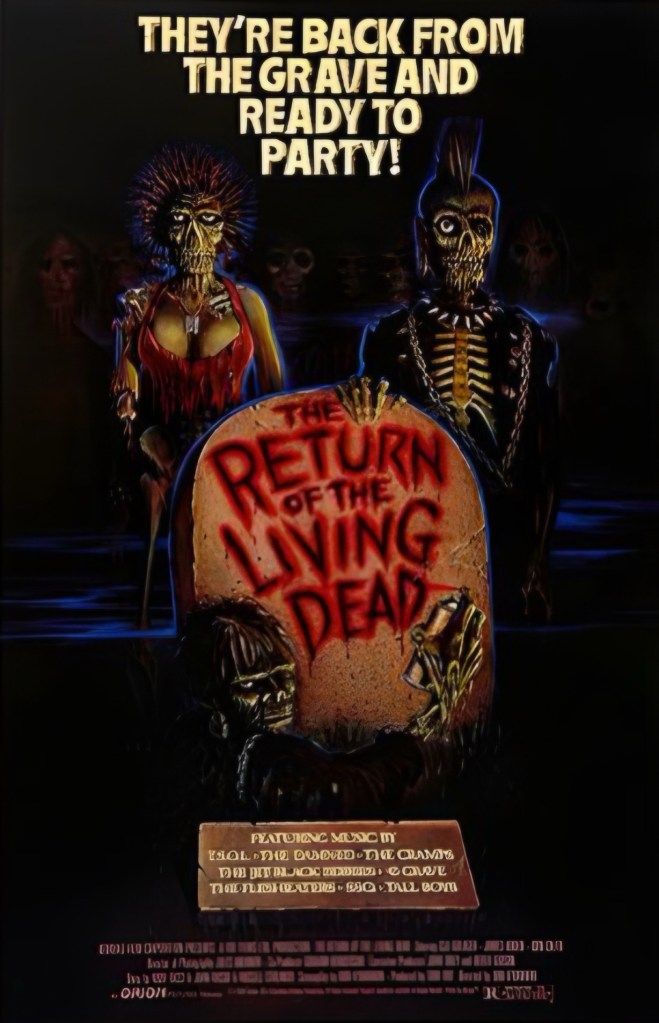
Before getting into the review, it’s important to explain how we got this film. Serving as a follow-up to Night of the Living Dead, John Russo and George A. Romero originally co-wrote a novel titled The Return of the Living Dead, which this film is based on. After Night, the two parted ways, with Russo retaining the rights to the “Living Dead” title while Romero continued with his “of the Dead” films. The Texas Chainsaw Massacre director Tobe Hooper was initially set to direct but dropped out to make Lifeforce, paving the way for Dan O’Bannon to step in — a move that ultimately resulted in one of the most legendary cult classics in horror.
Set on July 3, 1984, the film follows warehouse foreman Frank, who accidentally releases a military chemical called 2-4-5 Trioxin while trying to impress a new employee, Freddy. The gas reanimates a corpse and quickly proves that destroying the brain does absolutely nothing. When the body is cremated, the chemical contaminates the air, creating toxic rain that reanimates the dead in a nearby cemetery. Freddy’s friends, who are hanging out at the graveyard, are soon attacked as the outbreak spirals out of control. As zombies overrun both the mortuary and the warehouse, the survivors learn the horrifying truth: the undead feel the pain of decomposition, and eating brains is the only relief. With the situation completely hopeless, the military nukes the area — only for the Trioxin to spread even further, implying the apocalypse has only just begun.
This film is unlike anything else in the zombie genre. It has a raw punk-rock vibe and completely reinvented the mythology: zombies craving brains instead of flesh, being immune to headshots, and even talking — all unheard of at the time. I usually have issues when horror leans heavily into comedy, but it works perfectly here because the film fully commits to its tone. Between the fantastic effects and makeup and a great cast including Clu Gulager, James Karen, Thom Mathews, Don Calfa, Miguel Núñez Jr., and Linnea Quigley, it’s endlessly entertaining. Another huge standout is the soundtrack, which perfectly matches the film’s punk energy — the score, especially the Trioxin Theme, is incredibly memorable, and tracks like “Partytime” by 45 Grave are iconic and give the film its rebellious identity. And of course, you can’t talk about The Return of the Living Dead without mentioning the Tarman zombie, easily one of the most recognizable and creepy zombie designs ever put on screen and still a genre icon to this day. It’s an easy must-watch and an easy 7.5 out of 10.
Rating: 7.5/10
1. Dawn of the Dead (1978)
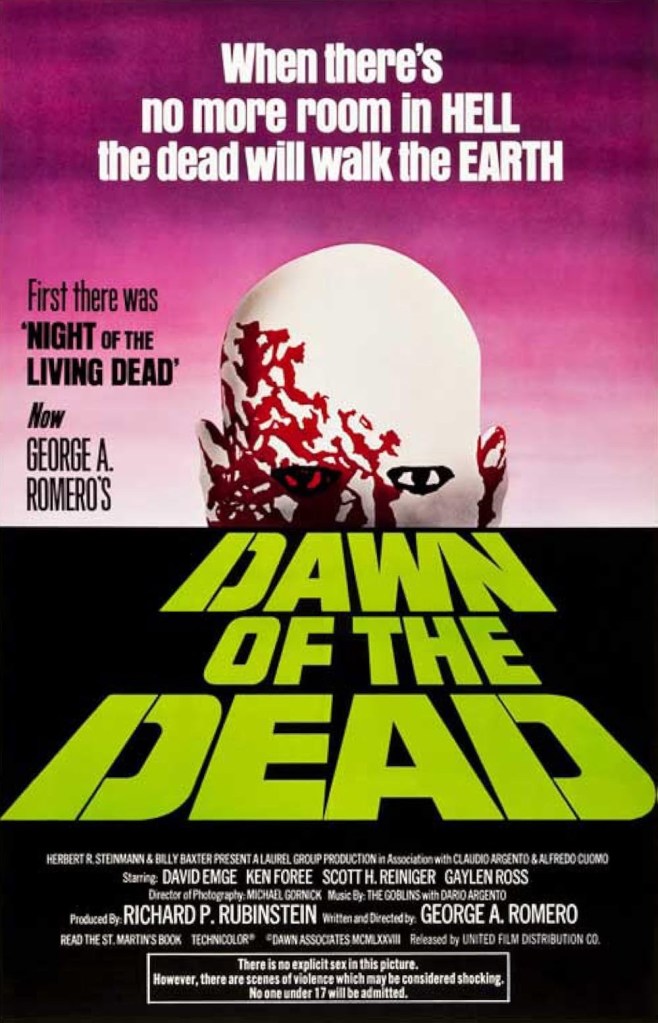
My favorite of Romero’s original Dead trilogy, Dawn of the Dead is an excellent film in my honest opinion. It’s a perfect mix of seriousness and humor when it needs to be, but unlike Night of the Living Dead, Romero deliberately embedded social commentary here — a pattern he would continue throughout his franchise. The film tackles consumerism, mindless routine, and our attachment to material possessions by setting the story in the Monroeville Mall. The dead return to the mall out of old habits, suggesting that even after death, people remain trapped in the same cycles they lived in. As Peter (Ken Foree) says: “When there’s no more room in hell, the dead will walk the earth.”
Speaking of Peter, I really liked all the main characters in this one — Peter, Roger, Stephen, Francine and even enjoyed Tom Savini’s villainous biker raider, which added a fun edge to the chaos. While Night of the Living Dead revolutionized the zombie genre, Dawn of the Dead is the film that popularized and mainstreamed it. It’s an outstanding movie, and easily one of my top five favorite zombie films — possibly even my number one. I’d give it an 8 out of 10.
Rating: 8/10
Well, there you have it — this has been an experience to say the least, from the highest of highs to the lowest of lows, with plenty of middling entries in between. I enjoyed it for what it was, but I wouldn’t recommend doing this yourself unless you’re as morbidly curious as I was. Based on my experience, you can safely skip pretty much anything rated 3.75 and below, while I highly recommend anything 4 and above. It’s also interesting to note that Tom Savini was involved in seven of these films in some capacity, whether through makeup and effects, cameos, starring roles, or directing, until next time ✌️

 The Classics with The Kidd